This topic has come up a few times recently. Several people have asked whether it’s true that we need more protein as we get older to maintain strength. The question usually arises after seeing articles, podcasts, or social media noise promoting high-protein diets or supplements, such as creatine. It’s a reasonable question. There is some truth in it, but it’s often oversimplified and taken out of context.
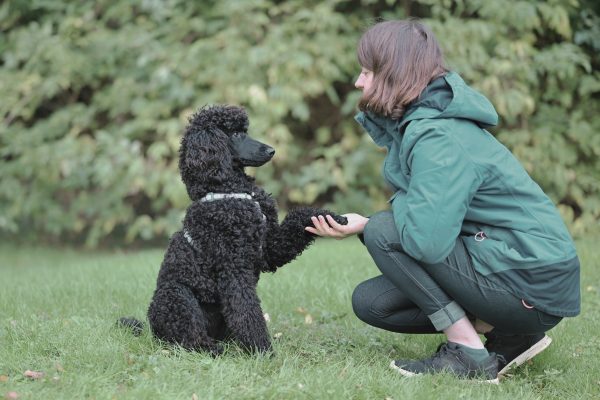
We know from both lived experience and research that strength declines with age. Most people first notice it in everyday tasks. Getting up from the sofa takes more effort. Sitting down on a train seat lands with more of a thud than it once did. Carrying shopping feels heavier. Climbing stairs becomes harder, and even caring for pets can feel more demanding.
These changes are often blamed on ageing alone. In reality, they reflect a gradual loss of muscle mass and a reduced responsiveness to protein. That distinction matters because it shapes what we do about it.
So what is actually happening in the muscle?
Research suggests adults lose around 3 – 8% of muscle mass per decade after the age of 30. The rate of decline often accelerates from midlife, particularly with inactivity. That said, the system is far from passive. Muscle still responds when it is challenged.
The difference is that, with age, the signal needs to be stronger. Both exercise and protein intake have to work harder to produce the same effect. This reduced sensitivity is known as anabolic resistance.
This is where the conversation often becomes skewed. The presence of anabolic resistance does not mean that muscle cannot adapt. It means the stimulus has to be appropriate.
A well-known trial in 1990 demonstrated this clearly. Nursing home residents aged 87 to 96 experienced significant increases in muscle strength and improved mobility after a short period of high-intensity strength training.
Why protein becomes more important
Muscle is constantly broken down and rebuilt. That process depends on two key factors: mechanical load and nutrition, especially protein.
In younger adults, relatively small amounts of protein are often enough to support this cycle. With age, the same intake becomes less effective. UK guidance suggests around 0.75 grams of protein per kilogram of body weight per day. Note that these amounts are intended to prevent deficiency, but may not be sufficient to maintain muscle strength and function.
Research suggests that older adults benefit from around 1.0 to 1.2 grams per kilogram, particularly if they are active or recovering from illness. This is consistent with guidance from groups such as the European Society for Clinical Nutrition and Metabolism.
It is not just the total amount that matters; how it is distributed across the day is important. The body uses protein more effectively when it is spread across meals rather than consumed in one sitting.
Practical points:
- Include a source of protein with each meal
- Spread intake across the day
- Increase intake slightly during periods of activity, illness, or recovery
I appreciate that this may be a challenge to those who traditionally don’t have breakfast and eat one main meal a day. It’s also worth noting that increasing protein intake isn’t always straightforward. Protein tends to be the most filling macronutrient, so eating more of it, especially in one sitting, can reduce appetite for other foods. For some people, this makes it harder to maintain consistent intake throughout the day.
There are also situations in which higher protein intake requires more careful consideration. For people with existing kidney disease, protein recommendations may differ and should be guided by a clinician. In otherwise healthy individuals, higher protein intakes within recommended ranges have not been shown to harm kidney function.
Why movement still drives the system
Protein alone is not enough.
If the muscle is not challenged, the protein you eat is not used as effectively. Muscle adapts to demand. Without that demand, the system downregulates.
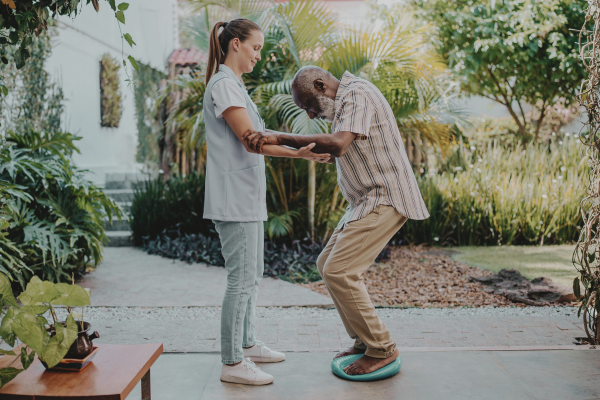
This is why resistance-based exercise matters. The key is not just movement. You do not need a gym, but you do need challenge and progression.
Even in very old adults, this still works. A well-known trial in nursing home residents aged 87 to 96 showed large improvements in strength and function following a short programme of high-intensity strength training.
What I noticed myself
My regular clients might remember the foot injury I sustained while travelling in Peru. It required several operations and a longer period of reduced activity than I had anticipated.
Even with my background and training, the drop in my overall strength was noticeable and happened faster than I expected. At the time, I put it down to the complexity of the injury and my age.
But that was only part of the story.
My strength did not return on its own in the way it might have years earlier. It improved only when I deliberately reintroduced load, gradually and consistently, and supported that with better nutrition, particularly protein spread across the day.
That experience shifted my thinking. It was not just about getting moving again. It was about providing a clear enough stimulus to adapt, and the resources to support it.
I see the same pattern in many midlife and older clients. Periods of inactivity, whether due to injury, illness, or life events, can lead to rapid declines in strength. Recovery is not automatic. It requires intent. Progressive loading, consistency, and adequate nutrition all need to be in place. Without that, it can feel as though strength has been lost permanently, when in reality it has simply not been rebuilt.
Where people get it wrong
A common mistake is treating protein and exercise as separate strategies.
They are not.
Eating more protein without challenging muscle does little. Exercising without adequate protein limits the response.
Another issue is assuming that all movement is enough. It is not. Muscles need a level of resistance that is sufficient to stimulate adaptation.
Where Pilates fits
People often look for structured ways to build strength that feel accessible and controlled. Pilates can work well for this, particularly in improving movement quality, joint stability, and coordination.
Regular Pilates practice can help people feel:
- More stable
- Less stiff
- More confident in their movement
This matters because strength develops more effectively when movement is well controlled.
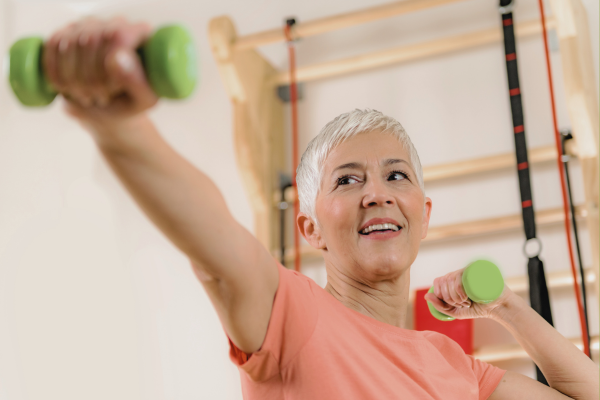
However, not all Pilates sessions provide enough resistance to maintain or build muscle, particularly in larger muscle groups such as the legs and hips. That is why I incorporate weights and other resistance into some classes.
The aim is not to turn Pilates into a gym workout, but to provide enough load for muscles to adapt. Weights also act as feedback. They make it clearer which muscles are working and which are not.
Strength, function and independence
Muscle strength underpins everyday function. It affects your ability to get up from a chair, climb stairs, carry loads, and maintain balance.
Lower strength is associated with increased risk of disability, hospitalisation, and loss of independence. Even grip strength is often used as a simple marker of overall health risk.
Strength is not the only factor in physical health, but it is a central one.
Common misconceptions
- Loss of strength is often seen as an inevitable part of ageing. In reality, large losses are usually linked to inactivity.
- Protein is often associated with athletes, but it is essential for everyone, particularly as we age.
- Muscle loss is typically slow, but it can occur quickly during periods of inactivity.
- What actually makes a difference
- Maintaining muscle strength comes down to two things working together:
- Regular resistance-based movement
- Exercises that challenge muscle at least twice per week
- Adequate protein intake
- More than the minimum recommendation, spread across the day.
- One without the other is less effective.
Final thoughts
Muscles change with age, particularly in how they respond to protein.
They do not stop adapting.
The most meaningful loss of strength comes from reduced stimulus, not from age alone.
If you challenge your muscles and support them with adequate nutrition, you can maintain and often rebuild strength.
It is not complicated.
Give your muscles a reason to stay and the support they need to do it.
Author
Sandie Ennis is an osteopath, Pilates teacher and clinical educator working in Dulwich and Central London. Her work focuses on hands-on treatment, therapeutic movement, and rehabilitation to help people maintain strength, mobility, and independence throughout life.
References
Fiatarone et al. 1994 high intensity strength training nonagenarians
Fiatarone, M.A., Marks, E.C., Ryan, N.D., Meredith, C.N., Lipsitz, L.A. and Evans, W.J. (1994) ‘High-intensity strength training in nonagenarians’, New England Journal of Medicine, 330(25), pp. 1769–1775.
Heo S et al. 2025 nutritional guidelines for sarcopenia
Heo, S. et al. (2025) ‘Nutritional guidelines for sarcopenia’. Available at: https://pmc.ncbi.nlm.nih.gov/articles/PMC12854796/ (Accessed: 17 March 2026).
Lee E et al. 2025 protein intake, physical activity, sarcopenia
Lee, E. et al. (2025) ‘Protein intake and physical activity in sarcopenia’, International Health, 17(4), pp. 423–431. Available at: https://academic.oup.com/inthealth/article/17/4/423/8115945 (Accessed: 17 March 2026).
Annals Academy of Medicine Singapore 2026 sarcopenia advances
Annals Academy of Medicine, Singapore (2026) ‘Sarcopenia: advances and future perspectives’. Available at: https://annals.edu.sg/sarcopenia-advances-and-future-perspectives/ (Accessed: 17 March 2026).